




 /
/
....
/Search Result
VN-Index 1,684.04
HNX-Index 248.68
VN30 1,837.43
Chúng tôi có thể giúp gì?
Có 52 câu hỏi
I want to update my CCCD on AAS Pro, what should I do?
How to Deposit Funds into Your AAS Securities Trading Account
| No. | Account Number | Bank |
| 1 | 2160639664 | BIDV – Dong Da Branch |
| 2 | 12221111119 | BIDV – Ha Thanh Branch |
| 3 | 0851000029629 | VCB – Ha Thanh Branch |
| 4 | 19122213441026 | TCB – Ba Dinh Branch |
| 5 | 1017682643 | SHB – Dong Do Branch |
| 6 | 141001536655 | VietinBank – Dong Da Branch |
Total Margin Debt
How do I find out if a specific stock I intend to purchase is eligible for margin lending from AAS?
What is margin trading? If I want to register for it, what are the required procedures?
What steps should I take if I forget my trading password/online trading password?
Why am I required to change my password upon my initial login?
What are the transaction fees at AAS?
AAS offers one of the most competitive transaction fees among full-service securities firms today, starting at just 0.15% of the transaction value (inclusive of exchange fees).
Clients at AAS can join our Investor Community and gain direct access to the Analysis Center for daily market updates, along with prompt support from our Customer Care Center.I would like to inquire about the documents required to open a corporate account
As per current regulations, the required documents to open an account for an organization/enterprise include:
- One (1) notarized copy of the Business Registration Certificate.
- One (1) notarized copy of the legal representative’s ID card (CMT/CCCD).
I currently have an account with another securities firm, and I would like to transfer it to AAS. What is the procedure for this?
An investor may open multiple securities trading accounts at different securities firms.
To transfer your trading activities to AAS, you must first open a securities trading account with us. You can then transfer your cash and securities balance to your AAS account to execute trades and utilize our full range of services. For further consultation, please contact our Customer Care Center via the hotline at 1900 1811 (extension 2) or email us at trungtamcskh@aas.com.vn.I have successfully completed the account registration via e-KYC. How soon will I receive a text message or email from AAS?
You will receive your account login credentials immediately upon completing the online registration. Please check the inbox of the email address you registered with to find this information.
In case you do not receive the email, please check all of your mail folders, including the spam folder. If you still cannot find the login email, please contact the AAS Customer Care Center via our hotline at 1900 1811 (press 2) or email us at trungtamcskh@aas.com.vn for timely assistance.I would like to open an account, but I am unable to visit an AAS transaction office. Are there alternative ways for me to open an account?
AAS provides a fast and convenient online account opening service. To open an account online with AAS and instantly receive your login credentials, please visit the link (here) or download the AAS PRO application and follow the guided steps at https://aas.com.vn/vi-vn/dich-vu/chi-tiet-bai-viet/moi-gioi-chung-khoan/co-phieu/A111/121613.
Upon successful completion and after receiving a confirmation email from AAS, your account will be ready to use. Alternatively, you can visit any of our AAS transaction offices nationwide to open an account in person and be guided on trading procedures by our specialists.I want to open an account but cannot visit an AAS branch. Is there another way I can open one?
- Original valid Citizen ID card (CCCD/CC), not blurred, shiny, or missing corners.
- Use a mobile device with a camera.
I have successfully registered for an account on e-kyc, how long will it take for me to receive a message or email from AAS?
I currently have an account at another securities company, now I want to transfer my account to AAS, what do I need to do?
I would like to ask what documents are needed to open an account for a business?
- Business Registration Certificate of the Enterprise: 01 notarized copy;
- ID Card/Citizen ID Card of the legal representative: 01 notarized copy;
What is the transaction fee at AAS?
Why do I have to change my password on first login?
What should I do if I forget my transaction password/online transaction password?
What is margin trading? What procedures do I need to follow if I want to register?
How do I know if the stock code I intend to buy is eligible for AAS margin lending?
Total margin debt
How to deposit money into a securities trading account at AAS
- 01 is the ordinary securities trading sub-account
- 06 is the margin securities trading sub-account
- 08 is the individual bond trading sub-account
- Beneficiary Name: Cong ty Co phan Chung khoan SmartInvest
- Content: CT TK so 111C……….+( Sub-account Number) of (Account Holder’s Full Name)
- List of accounts where Customers can deposit/transfer money to the Securities Account (TKCK) is as follows:
| No. | Account Number | At Bank |
| 1 | 2160639664 | BIDV – Đống Đa Branch |
| 2 | 1222111119 | BIDV – Hà Thành Branch |
| 3 | 0851000029629 | VCB – Hà Thành Branch |
| 4 | 19122213441026 | TCB – Ba Đình Branch |
| 5 | 1017682643 | SHB – Đông Đô Branch |
| 6 | 141001536655 | VietinBank – Đống Đa Branch |
How to withdraw funds from a securities account at AAS
- To withdraw cash directly from the securities account, customers are requested to come to the AAS transaction counter and fill out the available form. When transacting, customers must bring a valid ID card and sign with the correct registered signature specimen on the AAS withdrawal or transfer request form.
- Execution time:
- Morning: From 8:00 AM to 11:30 AM
- Afternoon: From 1:00 PM to 4:30 PM
- Customers access the AAS Online Trading page and Trading App to perform online money transfer from their securities account;
- Customers log in, then use the money transfer function on the system to execute money transfer orders to a Bank account;
- Execution time: From 8:30 AM to 4:30 PM.
Trading hours on UPCOM
| Transaction Method | Trading Hours |
|---|---|
| Continuous Order Matching I | 09h00 – 11h30 |
| Lunch Break | 11h30 – 13h00 |
| Continuous Order Matching II | 13h00 – 15h00 |
| Negotiated Transaction | 09h00 – 15h00 |
What is the fluctuation range on the UPCOM exchange?
- For stocks: ± 15%;
- For newly registered stocks traded on the first trading day and stocks that have not been traded for 25 consecutive trading sessions, on the first day of trading resumption, the price fluctuation range applied is ± 40% compared to the reference price.
- For bonds: not regulated.
Order matching principles on UPCOM
- Buy orders with higher prices are prioritized for execution.
- Sell orders with lower prices are prioritized for execution.
- In cases where buy or sell orders have the same price, orders entered into the trading system earlier are prioritized for execution.
Trading unit on UPCOM exchange
- For even lots: 100 shares/bonds;
- Odd lot trading units with a volume from 01 to 99 shares can be executed through both order matching and negotiated transaction methods;
- No trading unit is specified for negotiated transactions;
- Negotiated transactions and odd lot transactions are not allowed to be executed on the first trading day of newly listed shares or on the trading day after being suspended from trading for 25 days until a reference price is established from the results of the continuous order matching method.
Quotation unit on UPCOM exchange
- Quotation unit for stocks: 100 VND;
- No quotation unit specified for bonds and negotiated transactions.
Reference price on UPCOM exchange
Types of orders on UPCOM exchange
Trading hours on HSX
| Time | Trading method | |
| Morning session | 9:00 AM – 9:15 AM | Opening periodic order matching |
| 9:15 AM – 11:30 AM | Continuous order matching | |
| Lunch break | 11:30 AM – 1:00 PM | |
| Afternoon session | 1:00 PM – 2:30 PM | Continuous order matching |
| 2:30 PM – 2:45 PM | Closing periodic order matching | |
| Negotiated trading | From 9:00 AM – 3:00 PM (excluding lunch break) | |
| Bonds | ||
| Negotiated trading | From 9:00 AM – 3:00 PM (excluding lunch break) | |
Fluctuation range on HSX floor
- The daily price fluctuation range for stock transactions, closed-end fund certificates, and ETF certificates is ± 7%
- The price fluctuation range does not apply to bond transactions.
- The daily ceiling/floor price for stocks, closed-end fund certificates, and ETF certificates is determined as follows:
- Ceiling price = Reference price x (100% + Fluctuation range)
- Floor price = Reference price x (100% – Fluctuation range)
- The ceiling/floor price of warrants is determined as follows:
- Ceiling price = Warrant reference price + (ceiling price of underlying stock – reference price of underlying stock) x 1/Conversion ratio
- Floor price = Warrant reference price – (reference price of underlying stock – floor price of underlying stock) x 1/Conversion ratio
- For stocks, closed-end fund certificates, and ETF certificates where the ceiling-floor price, after adjusting for a ± 7% fluctuation range, is still equal to the reference price, the adjustment will be as follows:
- Adjusted ceiling price = Reference price + one tick size
- Adjusted floor price = Reference price – one tick size
- If the ceiling and floor prices of stocks, closed-end fund certificates, and ETF certificates, after adjustment as above, are zero (0), the ceiling and floor prices will be adjusted as follows:
- Adjusted ceiling price = Reference price + one tick size
- Adjusted floor price = Reference price
- If the floor price of a warrant is less than or equal to zero (0), the floor price will be the smallest tick size, which is 10 VND.
- For newly listed stocks, closed-end fund certificates, and ETF certificates, on the first trading day, the trading price can fluctuate within +/-20% of the expected trading price. The listing organization and the securities company acting as listing consultant (if any) must provide the expected trading price to calculate the reference price for stocks, closed-end fund certificates, and ETF certificates on the first trading day. If, within the first 03 trading days, newly listed stocks, closed-end fund certificates, and ETF certificates still do not have a closing price, the listing organization must determine the expected trading price.
- For (buy) warrants, the reference price on the first trading day is determined as follows:
- Warrant reference price = Warrant issuance price x (Reference price of underlying stock on the warrant’s first trading day / Reference price of underlying stock on the warrant issuance announcement date) x (Conversion ratio on the warrant issuance announcement date / Conversion ratio on the first trading day)
- For stocks, closed-end fund certificates, and ETF certificates that resume trading after being suspended for more than 25 days, the price fluctuation range on the first trading day is +/-20% compared to the reference price on the first day of resumed trading.
- For warrants, the reference price on the first trading day after being suspended for more than 25 days is determined as follows:
- The closing price on the first trading day after resuming trading will be the reference price for the next trading day. A 7% price fluctuation range will apply to the next trading day.
- If, within the first 03 days after resuming trading, stocks, closed-end fund certificates, and ETF certificates still do not have a closing price, HSX will consider adjusting the price fluctuation range for stocks, closed-end fund certificates, and ETF certificates after obtaining approval from the SSC.
Information on how to trade on HSX exchange
- Buy orders with higher prices are prioritized for execution;
- Sell orders with lower prices are prioritized for execution.
- In cases where buy or sell orders have the same price, orders entered into the trading system earlier are prioritized for execution.
- Odd-lot order matching transactions: 100 shares, closed-end fund certificates, ETF certificates, covered warrants;
- The maximum volume for a single order is 500,000 shares, closed-end fund certificates, ETF certificates, covered warrants;
- Negotiated transaction volume: from 20,000 shares, closed-end fund certificates, ETF certificates, covered warrants or more;
- No trading unit is specified for negotiated transactions;
- Transactions with a volume from 01 to 99 shares (odd lots) are executed directly between investors and securities companies.
| Price Level | Tick Size |
| < 10,000 VND | 10 VND |
| 10,000 – 49,950 VND | 50 VND |
| >= 50,000 VND | 100 VND |
- ETF certificates, covered warrants: a tick size of 10 VND applies to all price levels;
- No tick size is specified for negotiated transactions and bond transactions.
Types of orders on HSX exchange
- It is an order to buy or sell securities at the opening price;
- ATO orders are prioritized over limit orders during order matching;
- The periodic order matching session to determine the opening price will not determine a matching price if there are only ATO orders in the order book;
- ATO orders are entered into the trading system during the periodic order matching session to determine the opening price and will automatically be cancelled after the opening price is determined if the order is not executed or not fully executed.
- It is an order to buy or sell securities at a specified price or better. The order is valid from the time it is entered into the trading system until the end of the trading day or until the order is cancelled.
- Similar to ATO orders but applied during the periodic order matching session to determine the closing price;
- ATO (ATC) orders are prioritized over limit orders during order matching.
- It is an order to buy/sell securities at the lowest ask price/highest bid price currently available in the market;
- When entered into the trading system, a buy MP order will be executed immediately at the lowest ask price and a sell MP order will be executed immediately at the highest bid price currently available in the market. If the order quantity of the MP order is not fully executed, the MP order will be considered a buy order at the next higher ask price or a sell order at the next lower bid price available in the market and continue to be matched;
- If the remaining quantity of the MP order cannot be further matched after trading according to the above principle, the MP order will be converted into a limit buy order at a price one tick higher than the previous last traded price or a limit sell order at a price one tick lower than the previous last traded price;
- If the final execution price is the ceiling price for a buy MP order or the floor price for a sell MP order, the market order will be converted into a limit buy order at the ceiling price or a limit sell order at the floor price;
- MP orders are valid during the continuous order matching session;
- MP orders will be automatically cancelled if there is no corresponding limit order at the time of entry into the trading system;
- For foreign investors’ buy MP orders, if partially matched, the remaining portion will be automatically cancelled if the security reaches its foreign ownership limit (room).
- Only unexecuted orders or the remaining portion of unexecuted orders can be amended or cancelled during the continuous session;
- Orders cannot be amended or cancelled during the periodic opening and closing sessions (including orders carried over from the continuous session);
- Negotiated transactions cannot be cancelled.
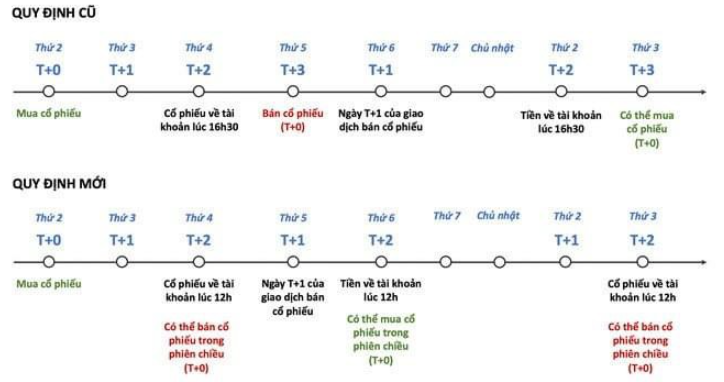
Settlement time on HSX exchange
- Stocks, closed-end fund certificates, ETF certificates, warrants: T+2;
- Corporate bonds: T+1;
- In case of warrant expiry:
- If investors hold warrants until expiry, the warrants are automatically settled if they are in a profitable state;
- Settlement time: E + 5 (E: warrant expiry date);
- Settlement method: By cash;
- Method: Direct allocation to securities account.
Foreign investor transactions on HSX
- The volume of shares and closed-end fund certificates purchased by foreign investors shall be deducted from the permitted purchase volume immediately after the buy order is executed; the volume of shares and closed-end fund certificates sold by foreign investors shall be added to the permitted purchase volume of shares and closed-end fund certificates immediately after the settlement of the transaction.
- A buy order or a partial buy order for shares and closed-end fund certificates by foreign investors that has not been executed will be automatically cancelled if the permitted purchase volume of shares and closed-end fund certificates has been exhausted or if it cannot be executed immediately upon entry into the trading system.
- The permitted purchase volume of securities for foreign investors will not change if the negotiated transaction is executed between two foreign investors.
Trading hours on HNX
| Trading Session | Trading Hours | Trading Method |
| Morning Session | 09:00 – 11:30 | Continuous Order Matching |
| Lunch Break | 11:30 – 13:00 | |
| Afternoon Session | 13:00 – 14:30 | Continuous Order Matching |
| 14:30 – 14:45 | Periodic Closing Order Matching | |
| After Hours | 14:45 – 15:00 | |
| Negotiated Trading | 09:00 to 15:00 (excluding lunch break) | |
Biên độ giao động trên sàn HNX
- For stocks: ± 10% compared to the reference price.
- For stocks, ETF fund certificates traded on the first day or the first day of trading again after being suspended from trading for more than 25 days: ± 30% compared to the reference price.
- For cases of paying dividends/bonuses with treasury shares to existing shareholders on the ex-dividend date: ± 30% compared to the reference price.
- For bonds: not regulated.
Information about how to trade on HNX
- Buy orders with higher prices are prioritized for execution
- Sell orders with lower prices are prioritized for execution
- In cases where buy or sell orders have the same price, orders entered into the trading system earlier are prioritized for execution
- For odd-lot order matching transactions: 100 shares/ETF certificates/bonds
- Negotiated transaction volume: from 5,000 shares/ETF certificates. No trading unit is specified for negotiated transactions of shares, ETF certificates
- Trading unit, minimum trading volume for bond negotiation: 01 bond
- Odd-lot trading units with a volume from 01 to 99 shares, ETF certificates, bonds are executed using both continuous order matching and negotiation methods
- Negotiated transactions and odd-lot transactions are not permitted on the first trading day of newly listed shares or on the trading day after a 25-day trading suspension until a closing price is established
- Order matching transactions for shares, bonds: 100 VND
- Negotiated transactions for shares, bonds: 1 VND
- ETF certificate transactions: 1 VND
- The closing price is the execution price of the last order match during the trading day (excluding orders matched in after-hours trading sessions)
- The reference price is determined by the closing price of the immediately preceding trading day
Types of orders applicable on HNX
- Limit orders are effective from the time they are entered into the trading system until the end of the trading day or until the order is cancelled.
- Market orders can only be entered into the trading system during the continuous order matching session.
- Market-to-Limit order (abbreviated as MTL) has characteristics similar to an MP order on HSX.
- Fill-or-Kill (FOK) market order (abbreviated as MOK) is a market order that, if not fully executed, will be cancelled from the trading system immediately after entry.
- Immediate-or-Cancel (IOC) market order (abbreviated as MAK) is a market order that can be executed in full or in part, with the remaining portion of the order being cancelled immediately after matching.
- ATC orders are effective during the closing periodic order matching session.
- Post-Closing Order (PLO)
- A PLO order is a buy or sell order for securities at the closing price after the closing periodic order matching session ends.
- PLO orders can only be entered into the system during the after-hours trading session.
- PLO orders are matched immediately upon entry into the system if there is a pending counter-order. The execution price is the closing price of the trading day.
- PLO orders cannot be amended or cancelled.
- In cases where the execution price cannot be determined during the continuous order matching session and the closing periodic order matching session, PLO orders will not be allowed into the system.
- Continuous order matching session: LO order
- Periodic order matching session: ATC, LO orders
- Price/volume amendments and order cancellations are only effective for the original unexecuted order or the remaining unexecuted portion of the order.
- During the continuous order matching session: limit orders are allowed to amend price, volume, and cancel orders during trading hours. The priority of an order after amendment is determined as follows:
- The order’s priority remains unchanged if only the volume is reduced.
- The order’s priority is recalculated from the time the amended order is entered into the trading system for cases of increased volume and/or price amendment.
- During the closing periodic order matching session (ATC): LO and ATC orders (including LO orders transferred from the continuous order matching session) are not allowed to be amended or cancelled.
- PLO orders cannot be amended or cancelled.
What is odd-lot stock trading?
Which type of securities is subject to odd-lot trading?
What should investors do if they want to trade odd-lot securities?
How would an investor place an order if they wanted to sell 109 shares of XYZ?
What are the regulations on tick size, quotation unit, and price fluctuation limit for odd-lot securities transactions?
Odd-lot stock trading methods and odd-lot stock trading hours?
What types of orders can investors use to trade odd-lot securities?
What is the prescribed payment time for odd-lot securities transactions?